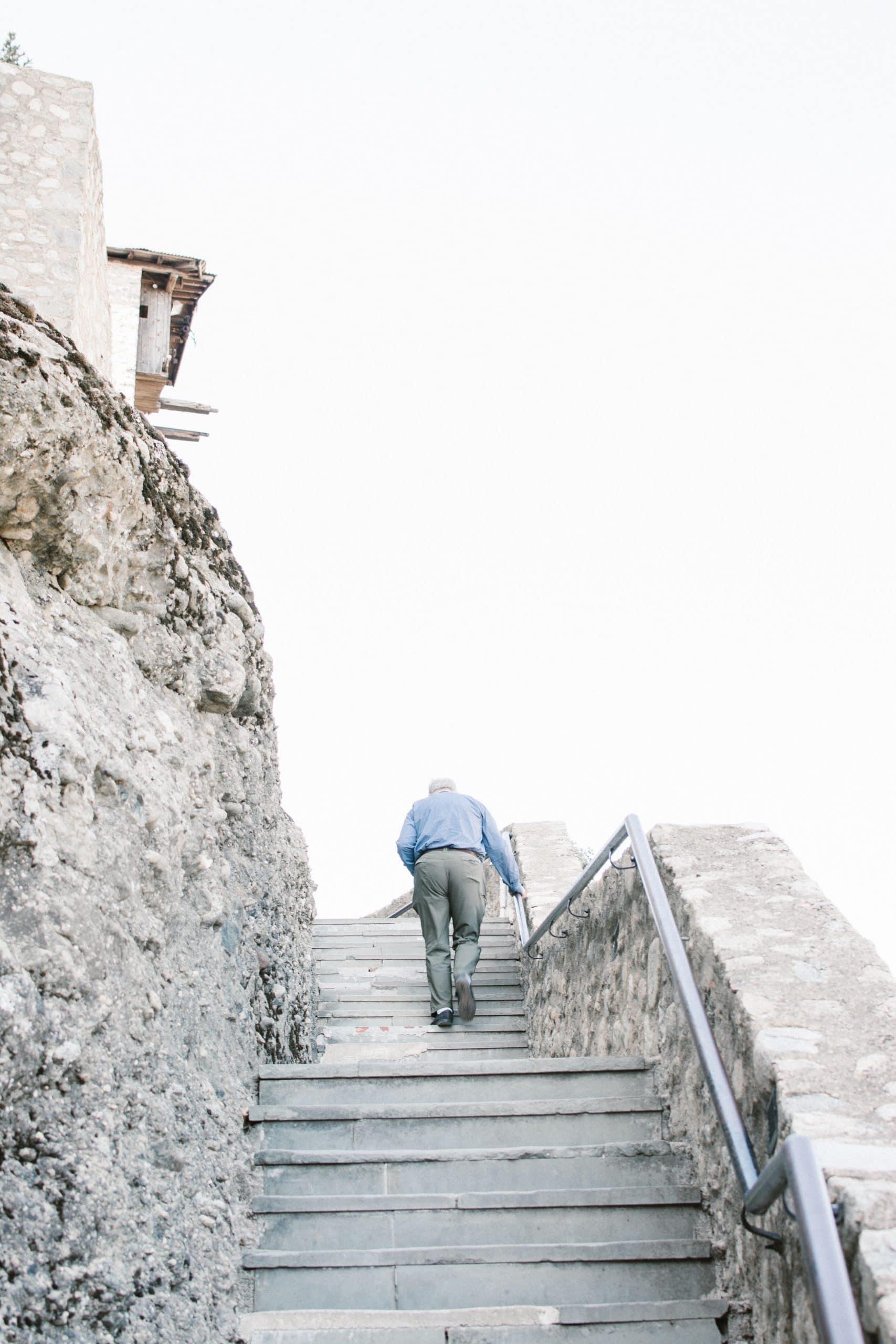
The exercises that make climbing stairs easier are the ones that strengthen your thighs, hips and calves and sharpen your balance, such as step-ups, heel raises, mini squats and side steps. In fact, the Australian Government’s physical activity guidelines for older Australians list climbing stairs itself as a strength activity, so the stairs can become part of your training rather than something you avoid. A few minutes of the right practice most days can help each flight feel more manageable.
In this article you will find out why stairs feel harder as we get older, which problem matches which exercise, five simple moves you can do at home, and a few safety habits that make every staircase safer. We will also cover when it makes sense to get a hand from an exercise physiologist.
Why do stairs get harder as we age?
Stairs ask a lot of your body at once. Every step up means lifting your whole body weight on one leg, while the other leg swings through and your balance holds you steady. Coming down is just as demanding, because your muscles must control the drop.
Over time, many people lose some strength in the big muscles at the front of the thigh, the buttocks and the calves. Stiff or sore joints can make you favour one side, and less time on your feet leaves your heart and lungs less used to short bursts of effort.
What is making stairs hard for you?
Not everyone struggles with stairs for the same reason. Working out what you notice most can point you towards the exercise that will help the most. Use the table below as a starting guide, not a diagnosis.
|
What you notice on the stairs |
Likely cause |
Exercise that helps
|
|---|---|---|
|
Sore knees, especially going down |
Weak thigh muscles not absorbing load, stiff or arthritic joints |
Mini squats, wall sits and low step-ups |
|
Breathless by the top of the flight |
Heart and lungs less used to short bursts of effort |
Regular walking plus repeated step-ups at a steady pace |
|
Wobbly or unsteady, grabbing the rail |
Reduced balance and weak hip muscles on the sides |
Side steps, side leg raises and heel raises |
|
Legs tire halfway up |
Low strength and endurance in thighs and calves |
Step-ups, heel raises and mini squats |
|
Toes catching on the edge of the step |
Weak hip flexors and reduced knee lift |
Knee lifts and step-ups |
Many people tick more than one row. Happily, the same few exercises cover most of these problems.
Five exercises to make climbing stairs easier
These five moves can be done at home with a sturdy chair, a wall or your kitchen bench for support. Move slowly and stop if anything feels sharp. If you have a heart condition, joint replacement or other health condition, check with your GP or an exercise physiologist first.
1. Step-ups
A step-up is the closest thing to climbing stairs. Use the bottom step of your staircase.
- Stand facing the bottom step, holding the handrail.
- Place your whole stronger foot on the step.
- Push through that heel to stand up tall on the step, bringing the other foot up to join it.
- Step back down slowly, leading with the weaker leg.
Reps: 8 to 10 on each leg, resting between sets. Work up to 2 or 3 sets.
Easier or harder: Use a lower, sturdy exercise step to make it easier. Make it harder by letting go of the rail lightly (only if your balance is good) or slowing the lowering phase to a count of three.
Safety tip: Keep your knee in line with your second toe, rather than letting it drift inwards.
2. Heel raises
Strong calves give you a push off every step and help with balance. The government guidelines include heel raises as a balance activity, starting at 8 repetitions and building to 15.
- Stand behind a chair or at the kitchen bench, holding on with both hands.
- Keep your feet hip width apart.
- Slowly rise up onto your toes as high as is comfortable.
- Hold for a second, then lower your heels slowly to the floor.
Reps: Start with 8 and build gradually to 15.
Easier or harder: Do them sitting down to begin with. To progress, hold on with one hand only, or do them on one leg at a time.
Safety tip: Lower slowly, as dropping quickly can upset your balance.
3. Mini squats and wall sits
Half squats are another balance activity named in the guidelines, and they build the thigh strength your knees rely on, especially when coming down stairs. A wall sit is the same idea held still.
- Stand with your back against a wall, or hold the kitchen bench, feet hip width apart.
- Bend your knees and push your hips back as though starting to sit.
- Go only part of the way down, to a depth that is comfortable.
- Push back up to standing. For a wall sit, hold the bent position instead.
Reps: Start with 8 mini squats and build to 15. For wall sits, hold for 10 to 20 seconds and repeat 3 times.
Easier or harder: Make it easier by bending less. Make it harder by going a little lower or holding a little longer.
Safety tip: Keep your weight through your heels and stop before any knee pain starts.
4. Side steps
Side steps strengthen the hip muscles that keep your pelvis level when you stand on one leg, as you do on every stair.
- Stand side on to the bench, holding on lightly.
- Step one foot out to the side, then bring the other foot to meet it.
- Take 10 steps in one direction, then 10 back.
- Keep your toes pointing forwards the whole time.
Reps: 2 to 3 lengths each way.
Easier or harder: Take smaller steps to make it easier. Add side leg raises (lifting one leg out to the side while holding the bench, starting at 8 and building to 15) for more challenge.
Safety tip: Clear the floor of rugs and cords before you start.
5. Knee lifts
Knee lifts help you raise your foot high enough to clear each step, so your toes are less likely to catch. The guidelines suggest 8 to 10 knee lifts on each leg.
- Stand tall holding a chair back or the kitchen bench.
- Lift one knee up in front of you, as if marching.
- Lower it with control.
- Repeat on the other side.
Reps: 8 to 10 on each leg.
Easier or harder: Do them seated to begin with. Progress by lifting a little higher or pausing at the top.
Safety tip: Stand tall and avoid leaning back as you lift.
If you would like a structured program built around these moves, our senior strength training sessions are designed with these everyday tasks in mind.
How often should you do these exercises?
Little and often works best. Aim to do the five exercises two or three times a week, with a rest day in between for your muscles to recover. Balance moves like heel raises and side steps can be done more often, even daily, because they are gentle.
The Australian guidelines also recommend at least 30 minutes of moderate activity on most, preferably all, days. That might be a walk around the block, a stroll from the car at Chadstone to the shops, or carrying the Coles bags up the front steps. It all adds up.
What if your knees hurt on the stairs?
Sore knees are one of the most common reasons people avoid stairs. Often the thigh muscles are not taking enough of the load, so the joint takes more strain.
If you have arthritis, start with the easiest version of each exercise and keep the range small. Mild discomfort that settles within a day is usually acceptable, but pain that is sharp or lingers is a sign to back off. Our guide to the best exercises for arthritic knees has more gentle options, and our osteoarthritis exercise program offers supervised support.
Safe stair habits and when to stop
Good habits keep you safe while your strength builds.
- Up with the good, down with the bad. Lead with your stronger leg going up and your weaker or sorer leg going down. Your strong leg does the hard work both ways.
- Always use the handrail. Hold it firmly, ideally on your stronger side.
- Take one step at a time. Bring both feet onto each step if that feels safer.
- Place your whole foot on the step. Hanging your heel off the edge makes slipping more likely.
- Keep stairs clear and well lit. Remove shoes, bags and washing from steps and use a night light for trips at night.
- Wear supportive shoes. Avoid socks or loose slippers on stairs, and take care on wet steps or uneven Melbourne footpaths.
Just as important is knowing when to stop. Stop exercising or climbing straight away and rest if you notice any of the following:
- Chest pain, pressure or tightness
- Dizziness, light-headedness or feeling faint
- Breathlessness that does not settle with rest
- Sharp or sudden joint pain
- A racing or irregular heartbeat
If symptoms like chest pain do not settle quickly, call for emergency help. For anything that keeps coming back, see your GP before you continue.
When to see an exercise physiologist
It may be time to get some expert help if you have started avoiding stairs, need to stop halfway, have had a fall or near miss, or are recovering from surgery such as a knee or hip replacement. The same goes if you have a health condition and are unsure which exercises are safe for you.
At Summit Health Group, an assessment with an accredited exercise physiologist starts with a conversation about your health, your home and your goals. We then look at your strength, balance and walking, and often watch you on a step to see exactly what is making stairs hard. Then we build a program that suits you.
You can see us at our clinics in Malvern and Blackburn, or we can come to you with a home visit and practise on your own staircase.
If stairs have started to feel like a mountain, you do not have to work it out alone. Book an assessment with our team and we will help you find a safe, practical way to keep climbing.